
Solving Cancer Care's Toughest Challenges with AI
We leverage Artificial Intelligence to transform complex patient data into actionable insights, addressing critical hurdles in diagnostics, treatment, and resource management.
Accurate Prognosis
Predicting patient outcomes and disease progression to inform treatment planning.
Risk Identification
Pinpointing key genetic, environmental, and lifestyle risk factors.
Resource Optimization
Guiding the efficient allocation of specialized treatments and personnel.
Insight from Data
Uncovering subtle patterns from vast datasets that are invisible to the human eye.
Our Solution: An Interactive Analytics Platform
We have developed a robust framework and an interactive web application built on a comprehensive dataset of global cancer patients from 2015-2024. Explore the key insights below.
Unique Patient Records
0
Countries Analyzed
0
Cancer Types Studied
0
Exploratory Data Analysis (EDA)
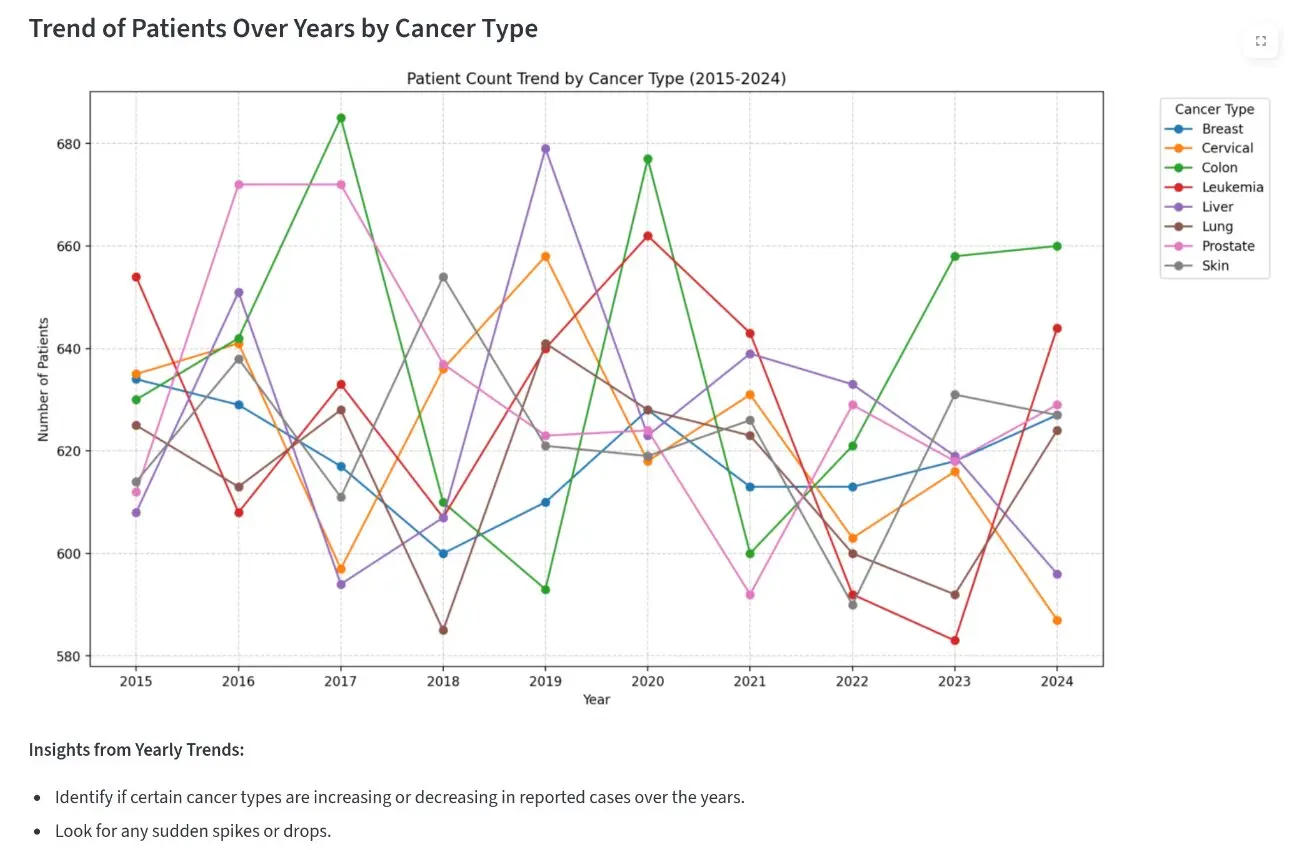
Visualize how the number of diagnosed patients has changed from 2015 to 2024 for different cancer types.
Compare the total number of patients across different cancer types or countries.
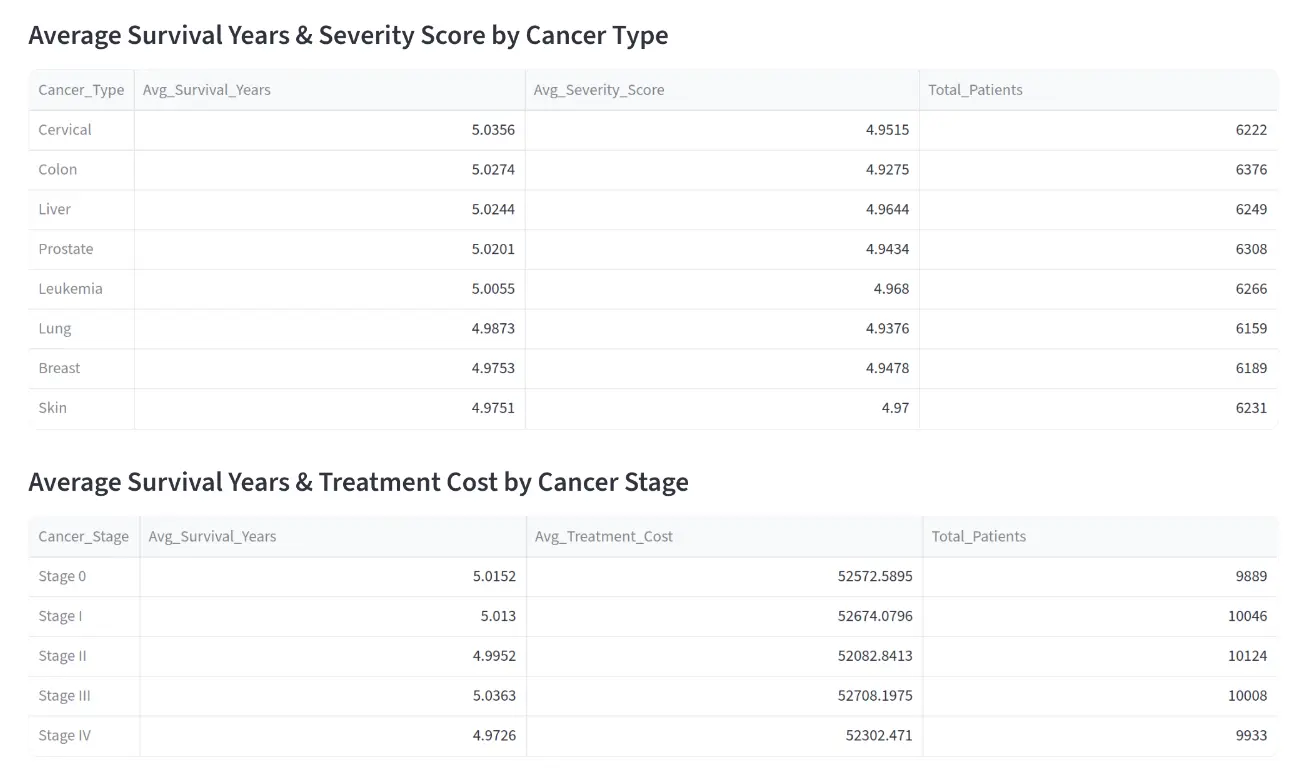
Explore the correlation between various risk factors and patient outcomes like survival years or severity score.
Practical Applications of Our Solution
Our platform provides a powerful foundation that can be adapted for various high-impact applications in the healthcare ecosystem.
Enhanced Prognosis
Utilize predictive models to estimate patient severity and survival years, aiding in care personalization.
Diagnostic Support
Suggest probable cancer types or stages based on patient profiles to guide diagnostic pathways.
Personalized Insights
Inform tailored treatment recommendations by understanding which factors impact outcomes.
Public Health Initiatives
Identify high-risk demographics and regions to enable targeted prevention and screening programs.
Resource Optimization
Forecast future demand for specialized care and equipment based on predictive trends.
Research Acceleration
Provide a robust platform for researchers to rapidly test hypotheses and explore data relationships.
Business Value and Future Vision
Business Value
- ✔Improved Outcomes: More effective diagnosis and patient management.
- ✔Operational Efficiency: Optimize resource allocation and streamline care pathways.
- ✔Cost Reduction: Minimize unnecessary tests and focus on early intervention.
- ✔Enhanced Decision-Making: Empower stakeholders with predictive analytics.
Market Needs
- ✔Precision Medicine: Tailoring treatment to individual patient characteristics.
- ✔Predictive Analytics: Forecasting disease progression and resource requirements.
- ✔Risk Stratification: Identifying high-risk individuals for early intervention.
- ✔Digital Health Tools: Integrating data analysis into clinical workflows.
Future Aspect
- ✔Integration with EHR: Seamless data flow for real-time insights.
- ✔AI-driven Drug Discovery: Accelerating identification of new therapies.
- ✔Wearable Device Integration: Incorporating continuous patient monitoring data.
- ✔Explainable AI (XAI): Providing transparent rationale for predictions.